
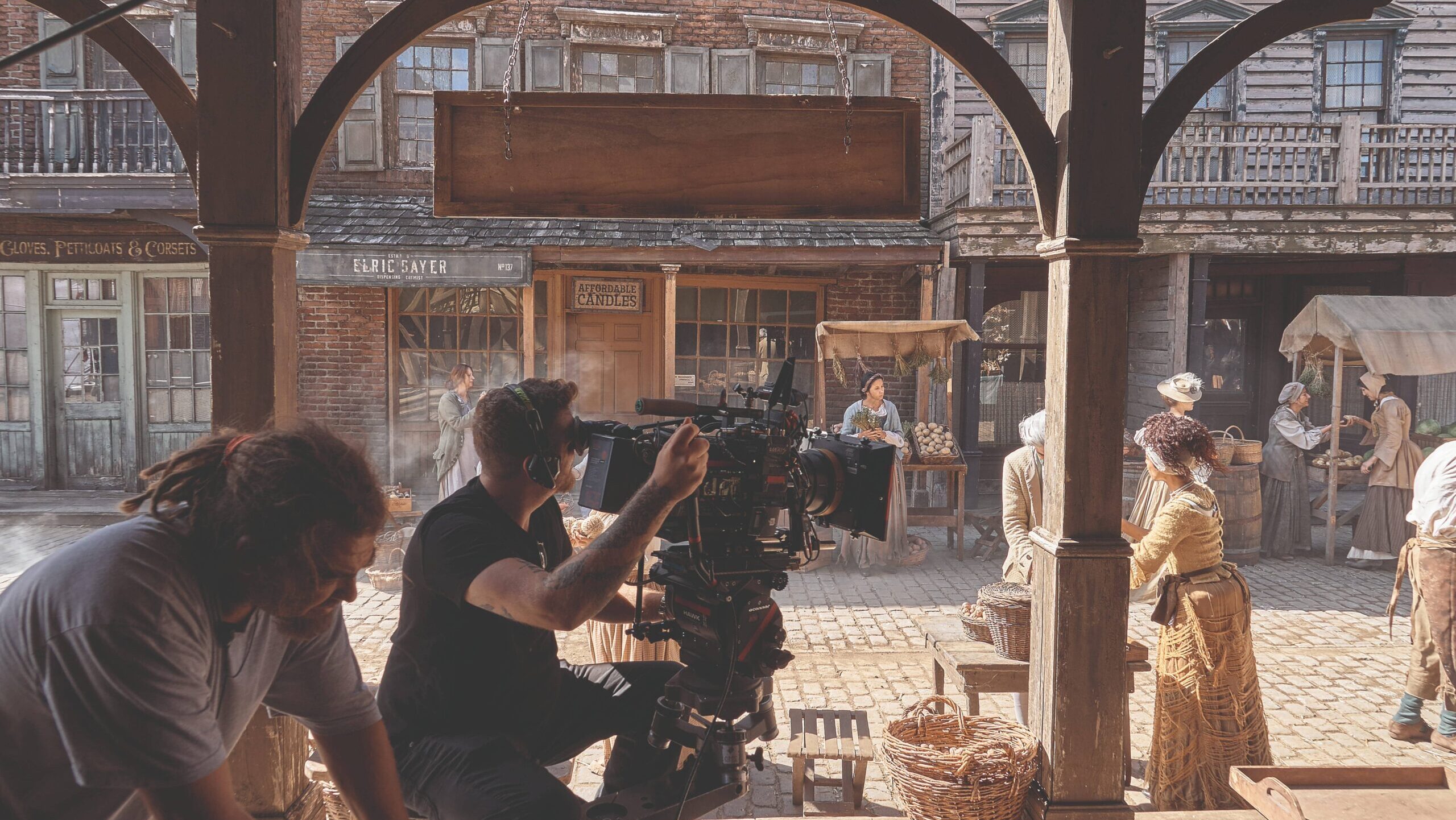
Production: Bedlam
Posted on May 8, 2026 by Admin
Big ambition met indie budget on Bedlam, an upcoming movie set in a 17th-century mental asylum. The project’s DOP & DIT discuss how they maximised their budget
Set in 17th-century London’s most notorious mental asylum, Bedlam is not a film that fears the dark –
in any respect. It follows a bare-knuckle fighter (played by Scott Adkins) infiltrating a hellish facility to break out his sister, wrongfully imprisoned there by the Duke of Cumberland. What awaits him is a world of damp stone, firelight and casual cruelty, where much of the drama unfolds in cramped cells and unlit corridors. “It’s both a prison film and an action film,” begins cinematographer James Butler. “But really it was people talking in the dark. We did not want it to look like a generic modern fight movie. It needed the weight and texture of a period drama as well.”
To achieve that, Butler pushed for a medium format digital negative built around the Blackmagic URSA Cine 17K 65, using almost entirely anamorphic lenses: on paper, a bold choice for an independent British feature. Blackmagic’s tech was central to the DaVinci Resolve pipeline, managed by DIT Mark Kozlowski.
“People obsess over resolution,” comments Kozlowski. “I was more interested in whether we could use this camera and Resolve to build a proper picture-to-post workflow that an indie could actually afford.”
Medium format meets anamorphic
The decision to go medium format was, Butler admits, semi selfish. “I had shot a lot of medium format stills, and I loved the separation you get – the relationship between faces and the background, the way it renders portraiture,” he says. “Even though this is a fight film, we wanted the dramatic scenes to stand up on their own. Most movies are two people talking in a room. If that looks beautiful and has some emotional weight, you’re in a good place before anyone throws a punch.”
With the budget available, there was only one realistic route to that look. “The only other option that would do what the URSA Cine 17K does was the ARRI 65,” Butler says. “And that was so far outside our world it might as well not exist. Rental alone would have eaten the budget.”
The URSA Cine 17K RGBW, 2.2:1 sensor presented a different opportunity: pairing a large format body with Hawk’s 65mm anamorphic glass. On paper, the combination sounded unwieldy, a wide sensor with a 1.3x squeeze and a lot of unused area. But for Butler, that was part of the appeal.
“I just like anamorphic,” he states. “I like what it does around the edges of the frame and that you can be slightly wider and closer and still get depth. I didn’t want sci-fi blue streaks or a Star Trek look. The way good anamorphics render faces – the falloff, the subtle distortions – feels cinematic to me. Medium format plus anamorphic was something I’d only really seen on big studio pictures, and usually on film. I had never seen anyone do it digitally at our scale, so I thought, if we could, why not?”
Testing at Hawk’s facility, Butler and the team cycled through 17, 12, 8 and 4K modes at different compression ratios, swapping Hawk 65 primes and zooms, and slowly arrived at a pragmatic sweet spot of 8K at 5:1 compression, constant bit rate. “Three to one and five to one at 8K were basically indistinguishable in terms of how far you could push them. Once we knew we only needed a 4K master, 8K 5:1 was the obvious place to sit,” Butler says.
With the format and lens choice locked, attention turned to shaping the URSA Cine 17K into an A camera package that could keep pace with a demanding production schedule.
Hawk, Horia Cojan and another operator worked with Ratworks to design a custom cage and baseplate for the URSA Cine 17K 65. The package was made to be compatible with standard AR and Steadicam plates, have space for SAM plates and accessories, and enough structure to move quickly between crane, tripod, Steadicam and AR without having to be rebuilt each time.
The Hawks themselves were not lightweight. “Some were 3.5 to 4kg lumps with 140mm front elements, while some were almost stubby by comparison,” Butler explains. “Horia spent days in prep running every single lens through the AR, writing a balance chart: where the camera sat on the plate, where the batteries went, where the box was, how the cables ran. Otherwise every lens change would have become a 20-minute re-rig.”
Drawing the frame
From the outset, Butler and director Jon Shaikh were clear that Bedlam was a widescreen film. “We are both suckers for scope,” Butler says. “So the delivery was always going to be 2.39:1. That was non negotiable. The question was how we would capture and crop to get there, how much we would throw away and how much safety we’d need if we had to reframe.”
Butler used a simple online aspect ratio calculator, inputting capture and delivery resolutions, the squeeze factor and the target aspect ratio to get a visual of what the sensor saw versus what would make it to the screen.
“It showed you the exact band you were keeping, what you were losing left and right side and what scaling factor you were applying,” he explains. “That was useful to know, but creatively I do not like thinking, ‘It’s fine, we will crop it later.’ For me, the frame is the frame. If Jon and I both liked what we saw in that 2.39 box on the monitor, that was the shot. I did not want to be watching playback thinking in percentages.”
The safety area around that box did get used, but only sparingly and deliberately. “On stunt days, we were dropping guys on their backs over and over,” Butler says. “If the boom sneaks in three times in a row and everyone is aching, you have to ask yourself if you really want to make the stunt performer do it a fourth time or if you can fix it. Sometimes a tiny rescale is kinder and completely invisible.”
That attitude also fed into how the team managed exposure on the darkest material. “Dark scenes were purposely overexposed by one stop so that the shadows remained detailed and dense when the image was pulled in post.”
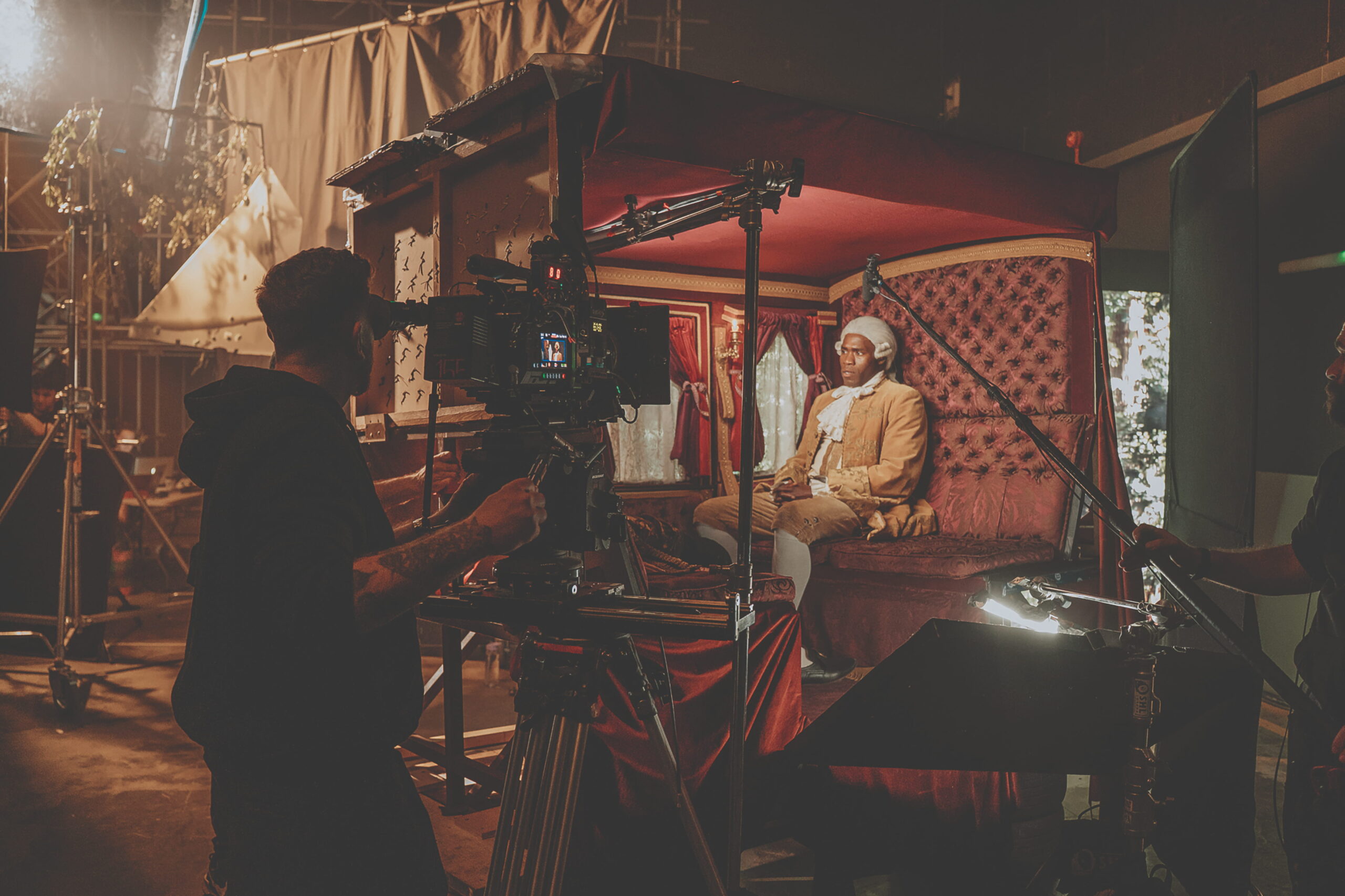
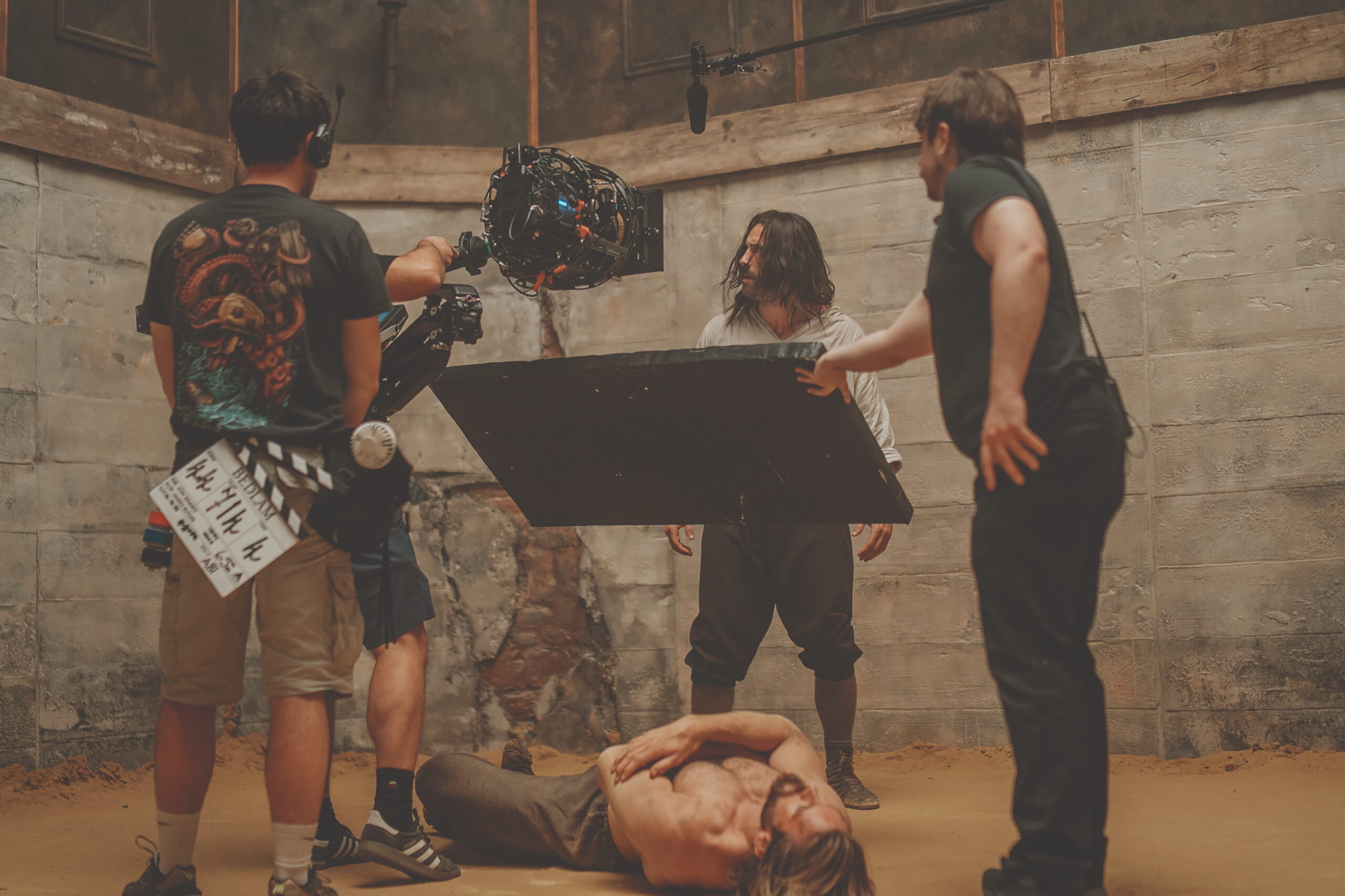
Firelight flickering in the last circle of hell
If the format choice gave Bedlam scale, the lighting strategy gave it teeth. Butler tended to start from the existing light in a space, even when that ‘existing’ light was entirely constructed. “I was usually looking at the room thinking, if this really existed in this period, where would light be coming from?” he says. “How does it
sit naturally? Then you augment that.”
For Bedlam, he and Jon broke the asylum into three distinct strata. At the top, there was the gallery level, the part open to fee-paying members of the public, which was relatively clean and presentable. Below that were Jack’s cell and the women’s ward, which were essentially single-source environments with a narrow window or a candle. Deeper still lay the criminal ward.
“That was the last ring of hell,” Butler describes. “No daylight, no windows, nothing. The only thing penetrating that space was fire.” They could have faked it with LED units, fire effects, banks of bulbs on tinfoil and all the usual tricks, but in practice, the sets and schedule made it easier and better to go as real as possible.
“In those criminal ward sets, there was nowhere sensible to rig large fixtures,” Butler says. “You were in these stone tunnels. Everything was low and cramped. We ended up relying heavily on handheld torches and fire pits for the main effect, then sneaking Astera tubes in just to give us a whisper on faces.”
A scene with Jack and Sarah cowered inside a pitch-black cell, while the ‘beast’ tore through guards in the corridor, tested limits. The only light on the actors was what spilled past the door as bodies and flames crossed the frame. “We shot most of that at around ISO 1250,” Butler comments. “On the monitors it was right down at the bottom of what you could see. I remember going to Mark and saying, ‘I think I might have completely messed this up.’”
Kozlowski’s first line of defence was always on-set monitoring and scopes. “You look at it with the LUT on, you look at the histogram, the waveform and you ask if there is actually something there or if you are kidding yourself,” he says. “In Rec. 709 terms it was hanging on, but I could see enough. I said, ‘It is OK. You are going to lose some of the absolute deepest shadow structure, but we can do something with this.’”
The second line of defence was DaVinci Resolve itself. As soon as the card landed at his station, Kozlowski dumped the rushes onto his NVMe RAID, pulled them into the same LUTed environment he had used throughout and did a quick pass.
“I always say, if I am worried, James will know about it,” he says. “In this case I brought him over, graded it live, lifted it, shaped it, then brought it back down. The important stuff was all there: tiny bits of chair in the background, texture in the stone, not just a black hole. That is what you need. In the dark at home you might not consciously see it, but you feel it. That is the difference between elegant blacks and just a lump of nothing.”
Cloud workflow on an independent budget
The pictures would have been academic without a workflow that could keep up, and there was also no appetite for an expensive, multi-platform pipeline. “At the budget level we were on, no one was booking a cinema, running a projector and paying overtime for everyone to sit there every night,” Kozlowski states. “The money just did not exist. Traditionally you end up fudging it yourself on whatever you can afford.”
Bedlam took a different route. Butler opened a DaVinci Resolve collaborative project and Blackmagic Cloud account at the start of the shoot. Over time, about half a dozen people were in that project: Butler, Kozlowski, the executive producer, the producer, an assembly editor, an assistant and eventually the main editor.
“It cost me £12.50 a month,” Butler says. “That was our entire proxy storage – the collaborative workflow, all the metadata, pre grades, everything. On the last film I did, my Frame.io account alone was around £130 a month, plus whatever the producers were paying for storage.”
The constraints of indie production still bit. In Romania, Starlink dishes and long Ethernet runs battled two-metre-thick prison walls and historic buildings that killed wireless signals. In the UK, time and infrastructure were equally tight. “Once you are underground in a fortress, if your Teradek dies at ten metres, never mind Wi-Fi,” Butler says. “On some days, we had three Starlinks just to get a trickle of upload. There were spots where Mark was working offline and syncing later.”
But the core idea held: one shared DaVinci Resolve project, proxies feeding straight into editorial and grading tools available from day one. Kozlowski’s station ingested the 8TB Media Module onto production RAIDs and his own NVMe system, created proxies, applied the show LUT and metadata and pushed everything into the shared project.
“The thing everyone underestimates is the metadata,” he argues. “If you can keep that clean, you can fix almost everything else. We had the digital slate writing scene and take, environment, lens and all that good stuff in the files. I added custom fields for UK slating, slate, shot, take, fixed the inevitable fat-finger errors and built smart bins so you could just punch in ‘C57’ – and everything for that slate appeared. Nobody had to rename clips. The burn-ins showed everything you needed.”
That discipline paid off when the unit wrapped. “Four days after principal photography finished, there was a complete assembly of the film. Not just a string out, but an actual one-hour-and-50-something cut of every scene, graded to our LUT, with all sound and metadata in place. On every other feature I have done, the assistant editor starts after wrap, spends two or three weeks just building bins and syncing, and then the editor comes in. You are months away from seeing the film. Here, we stole that time back during the shoot.”
This article appears in the April/May 2026 issue of Definition