
Review: Fujifilm GFX Eterna 55
Posted on Feb 25, 2026 by Admin
Cinematographers Nick Morris and Ailsa Aikoa get to grips with the hotly anticipated Fujifilm GFX Eterna 55
Large format sensor and recording options
The Fujifilm GFX Eterna 55 features a large 43.8×32.9mm sensor with a 4:3 aspect ratio, placing it in a distinctive position between full-frame and modern 65mm systems. By sensor width, it’s approximately 23% smaller than the ALEXA 65 and around 19% larger than the ARRI ALEXA Mini LF – offering a format that sits somewhere between established categories.
The 4:3 sensor makes it perfect for 2x anamorphic shooting, and we both expect to see a lot of medium format anamorphic work using this camera. In terms of recording modes, Fujifilm offers a wide selection, including 4:3 Open Gate to take advantage of the full sensor; GF DCI which gives you full width in 16:9; Premista DCI that focuses on the image circle of Fujifilm’s own Premista lens range; 35mm DCI for simple full-frame shooting; 8K Mode which prioritises the highest-resolution output while being slightly smaller than full-frame and Super 35 mode.
Where the Eterna 55’s ambitions become more clearly defined is in its recording options. For many high-end workflows across commercials, features and HETV, 12-bit recording is desirable. The Eterna 55 tops out at 10-bit ProRes 422 HQ internally, with the option for 12-bit Raw available externally. While this will be sufficient for a range of productions, the 10-bit internal ceiling may give some higher-end users pause, particularly for more-demanding grading pipelines.
Body design, lens mount and usability
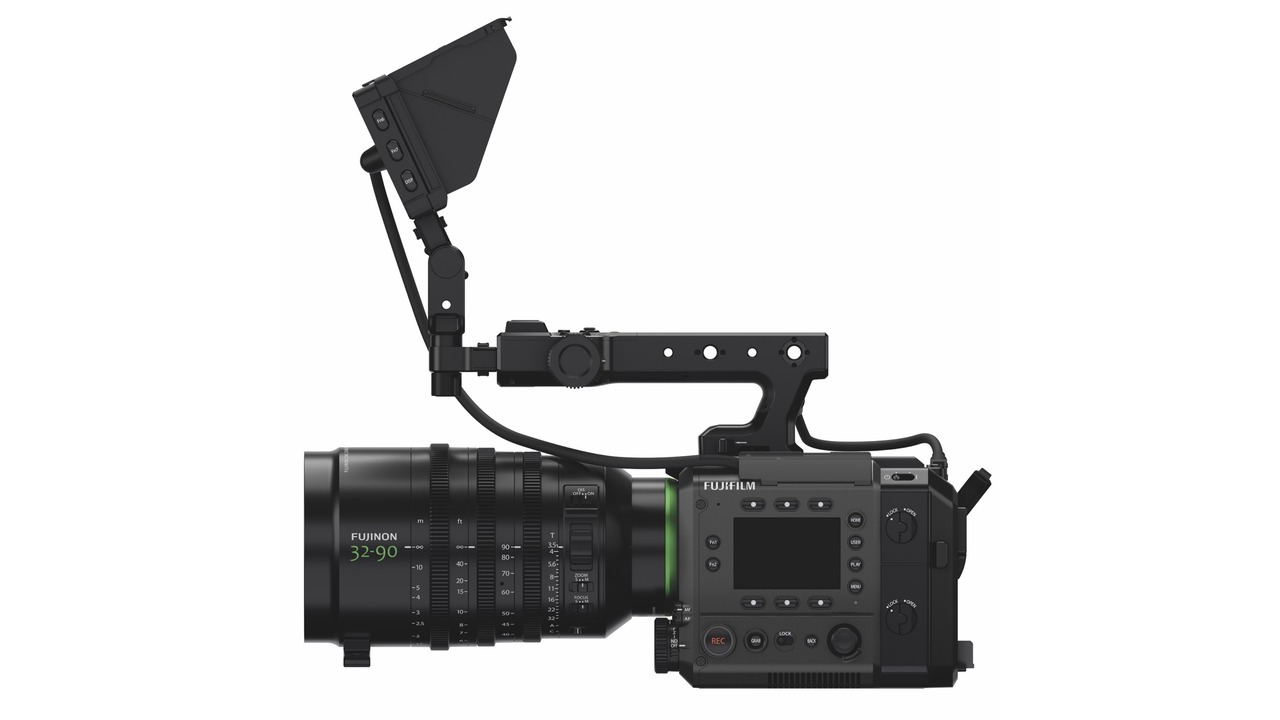
Given the size of its sensor, the camera comes in a surprisingly compact form factor. In the hand, it feels like something between a Sony FX6 and a Sony VENICE. Its longer, rectangular body departs from the cube-style designs common elsewhere, and features various user buttons and dials that can provide an intuitive approach to camera control. The top handle is particularly well considered and can slide along a captive rail for optimal balance, while also featuring a thumb rocker, run/stop button and rotating, multifunction dial that can be assigned to focus, zoom, iris or the stepless internal electronic ND.
The Eterna 55 is clearly targeting a range of users with its G Mount base, allowing adaptation to traditional cinema lenses with G-to-PL or LPL mounts, while also supporting stills and prosumer lenses with electronic control. Testing the camera with an LPL mount and Kipon’s LPL-Mamiya 0.7x focal reducer, we were able to see the full image circle of our medium format Mamiya primes. The G Mount has a locking flange which beds your mount of choice solidly to the camera body, so there was no play at all in our LPL set-up.
The internal electronic variable ND will be a major selling point for many users, and the image remains impressively free of colour shifts across the ND range. The filter begins at two stops from clear, then adjusts smoothly up to seven stops (2.1 ND) in extremely fine 0.015 ND increments. These steps are small enough to allow exposure adjustments to be made mid-take, although a keen eye may still notice subtle stepping.
The body feels robust while remaining pleasantly lightweight, and it’s clearly designed to transition between self-shooting, ENG-style set-ups, stripped-back gimbal builds and larger studio configurations. On the operator’s side of the camera, there is a second programmable, rotating multifunction dial, which feels intuitive for adjusting exposure with the ND on the fly. An excellent feature is the internal hot-swap battery located above the media slots. This battery charges automatically when external power is connected (via a V-Lock or similar), and will keep the camera alive for up to 30 minutes if the main battery is removed or fails. It not only protects the shot, but also allows battery changes without powering down. It’s a feature we’d love to see standardised across more cinema cameras, and the fact that Fujifilm chose a removable internal battery, rather than a sealed unit that would degrade over time, is a smart design decision.
The camera provides a single 2-pin power output on the front of the body, which is convenient for powering a monitor but can lead to less tidy cable runs given the rear-mounted SDI output. In practice, most productions will rely on additional power distribution for accessories regardless.
Monitoring, colour tools and workflow
Large control LCDs on both sides of the camera reinforce its hybrid design, allowing operators and assistants quick access to settings. The menu system is logically laid out and familiar to anyone experienced with cinema cameras, while dual native ISO switching occurs automatically once ISO 1600 is exceeded.
When paired with a G Mount autofocus zoom, the multifunction dial offers an intuitive way to pull focus, and the on-screen focus scale is a nice touch. However, during our testing, the onboard monitor flickered a little when adjusting focus via the wheel, which made critical focus harder to judge. Fujifilm has since released a firmware update that includes improvements to monitor behaviour, which may address this issue.
The Film Simulations – drawing on Fujifilm’s stills ecosystem – are nice to have and will be a big plus for some DOPs, but we found them to be a mixed bag for cinema use. Best for us were the ETERNA and ETERNA Bleach Bypass simulations, which nodded most meaningfully toward cinema stocks.
We were surprised by how indirect the Rec. 709 monitoring experience feels. While the SDI and HDMI outputs can be configured to display Rec. 709, Film Simulations form the basis of the camera’s default monitoring looks, which makes it harder to evaluate Fujifilm’s colour science on neutral terms in day-to-day use. Compounding this, when recording in F-Log there is no simple way to apply Film Simulations to monitoring without loading LUTs into the camera, which somewhat undermines the immediacy of having so-called ‘built-in’ Film Simulations for lots of Log-based workflows.
Image quality and grading performance
In post-production, the camera’s claimed 14 stops of dynamic range become apparent, particularly in its clean high-ISO performance. However, highlight handling proves more challenging, with roll-off into clipped whites that can be difficult to manage in more contrasty settings. When pushing grades creatively, these limitations are more apparent while working with the camera’s internal 10-bit recording, particularly in subtle colour gradients. Although, the option for external 12-bit RAW capture does provide additional latitude for workflows that require it.
That said, much of the excitement surrounding this camera bypasses these technical considerations entirely, and for good reason. People are here for its 4:3 medium format sensor, and that is where the Eterna 55 genuinely stands apart from the Super 35 and full-frame incumbents. A surprising number of lenses (whether intended to or not) cover the GFX sensor, and the extra real estate provides a new playground of looks.
Focus pullers will sweat at the likely upcoming trends of extreme shallow focus that the sensor size makes possible, but for cinematographers the expanded canvas invites exploration of medium format glass, as well as rediscovery of familiar lenses through previously unseen edges of their image circles.
Conclusion
In this world of huge sensors, there is little competition, especially at more accessible price points. The ALEXA 65 and 265 are probably out of reach for anyone not on a Marvel movie, leaving the Blackmagic URSA 17K as its closest rival. Even then, the Blackmagic costs roughly 50% more, placing it in a bracket of its own.
As a filmmaking tool, the Eterna 55 offers genuine, IMAX-certified large format credibility with its huge sensor, and when exposed and shot carefully it can make for some truly spectacular images that are difficult to achieve with smaller formats. We can imagine strong uptake among filmmakers seeking a distinctive, large format look without the cost of other true 65mm systems.
This article appears in the February/March 2026 issue of Definition