
Colour special: The future of colour in motion picture
Posted on Aug 5, 2025 by Admin
Daniele Siragusano, image engineer at FilmLight, considers the impact of machine learning on the craft of the colourist
At FilmLight, we’ve always understood that what a camera captures isn’t the finished picture you see on screen. It captures a raw ingredient – a latent image. Whether it’s classic film or a digital sensor, both record a wealth of information about light and colour that needs to be precisely developed and shaped to convey a certain story. This unprocessed data might be incredibly rich in information, but requires sophisticated modification to become the pleasing rendition we call a motion picture. The days of digital being aesthetically inferior to film are largely behind us too; modern digital cameras, when properly handled, can achieve unparalleled levels of abstraction and immersion. Our mission is to provide the tools to unlock that potential.
For years, colour manipulation tools have been deterministic – you adjust one setting and the image will change predictably. We’ve built our reputation on providing colourists with precise control over these tools, allowing them to sculpt every nuance of an image. Looking ahead – thanks to advancements in machine learning (ML) – we’re entering a new era of image modification. We’ll see functions that can analyse entire images, or sequences of images, to understand them in profound, abstract ways. This opens up all sorts of possibilities.
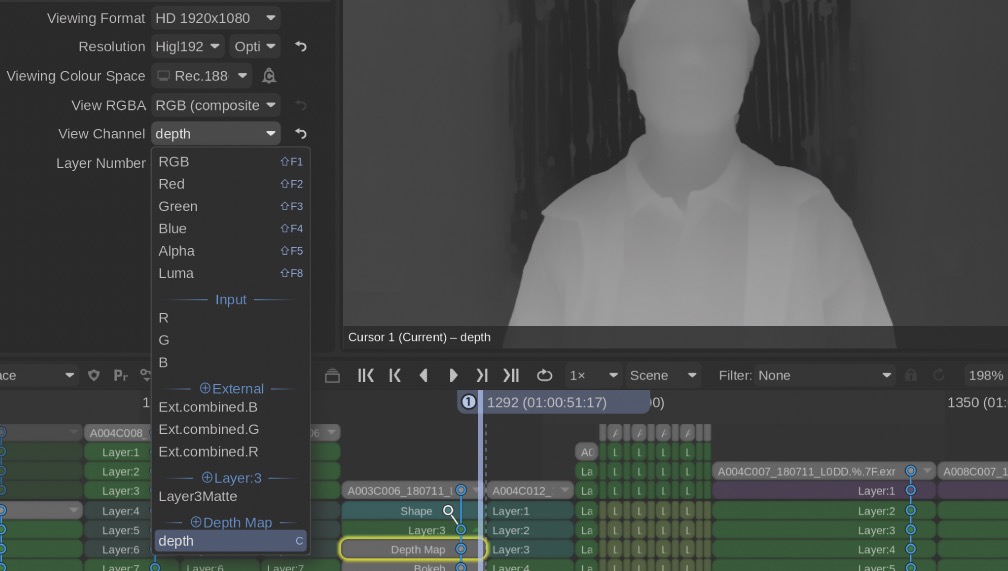
Our systems will be able to reconstruct even more from camera data, providing valuable additional information like depth maps, object segmentation or precise shading data. This will enhance creative freedom and accelerate the realisation of a director’s vision. We’re committed to making this rich data accessible and actionable within our tools. Most of our current development effort is providing robust infrastructure to facilitate these new additional channels of information.
Due to this, we’ll discover entirely new ways to modify images and movies by manipulating these underlying abstract representations. While some of these new functions might seem chaotic initially – a small change in input potentially leading to a significant output difference – our approach at FilmLight is to harness this power responsibly. We envision these AI-driven functions feeding into our familiar, highly predictable colour manipulation tools, allowing a human colourist to fine-tune and guide it. This ensures that art always remains in the hands of the artist.
ML functions will enable automation of many time-consuming, non-creative tasks, like the tedious work of rotoscoping, shot balancing or precise process matching. We don’t need 100% perfection from these functions because the human colourist can always refine.
It won’t replace human creativity; but it could empower it. By streamlining these technical tasks, we allow colourists to focus their time and talent on truly creative work that adds value to a project. This new technology can provide suggestions, enabling a more efficient and creatively focused workflow.
We’re driven by two core principles that define our entire development philosophy. Firstly, does new tech provide a higher or different form of creative expression? And secondly, does new tech increase efficiency without compromising creative expression? If a technology meets both criteria, it can become integral to the filmmaking process.
We pioneered and refined digital colour grading, which is a prime example of this success. We believe these new computational methods, especially those leveraging ML, will profoundly and positively shape the future of colour for the next decade. We’re dedicated to integrating these advancements into our Baselight systems in a way that respects the craft and artistry of colour grading, while enhancing creative control and dramatically improving workflow efficiency. Our goal is to ensure that, as technology evolves, it always serves the ultimate purpose: helping filmmakers tell their stories.
This article appears in the July/August 2025 issue of Definition